.png)

Wearable Health Beyond the Wrist (and Ring) Part II: What Everyday Wearables Could Become
Updated: Apr 21

I was recently on a call with a podcaster—an affable, extremely knowledgeable person, and, like many people in the health tech space, wearing an Apple Watch and an Oura ring.
Efficient. Sensible. Almost conspicuously well instrumented.
Which all tracked nicely with the conversation. Predictably, we circled the usual territory: bio-signals, insights, adherence, accuracy…everything tech is trying to achieve.
And then I noticed something else.
He was wearing a baseball cap.
Not a prototype. Not a lab experiment. Just a hat. Something he put on without thinking and wore without effort, which is the most important feature any health tech device can have.
The Wearables That Win
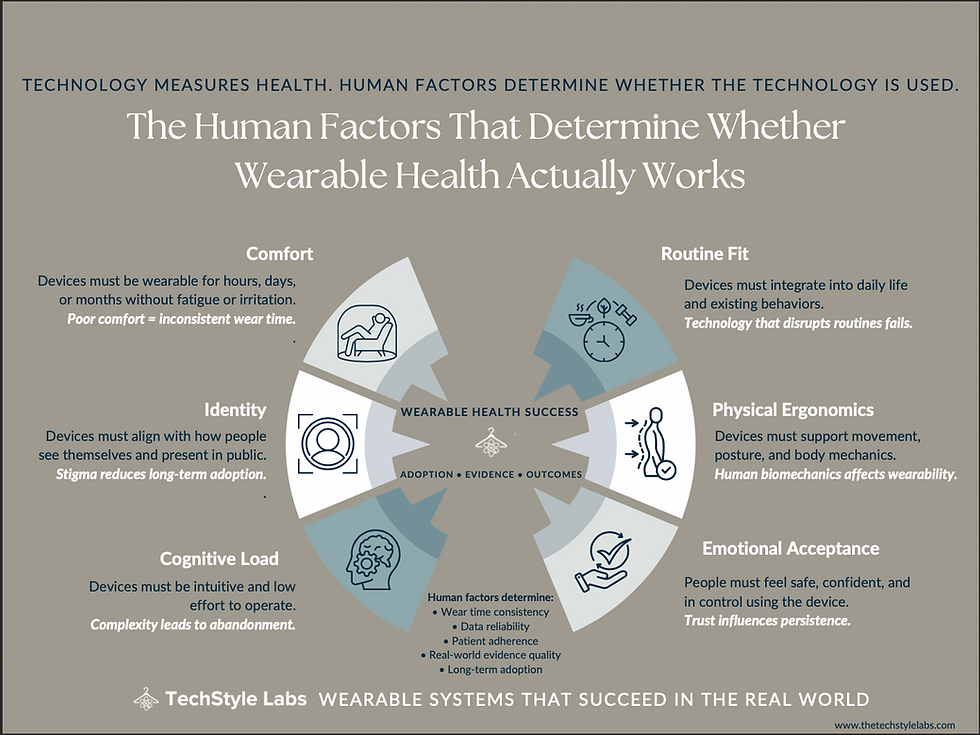
Wrist and ring-based wearables didn’t succeed because they were clever. They succeeded because they were livable.
They share a few unglamorous but decisive qualities: They’re socially normal. They’re physically unobtrusive. They integrate into normal daily routine. They don’t ask use to become hyper vigilant data collectors.
In short, they fit into real life. And while the industry loves to debate what wearables can measure, the real question, the one that quietly determines who winsis what they ask of the people wearing them.
Looking Up: The Opportunity in Plain Sight
That hat lingered in my mind.
If we’re serious about moving wearable health beyond the wrist, the first question probably isn’t “What else can we build?” It’s “What are people already wearing—consistently, comfortably, and without complaint?”
Hats are surprisingly compelling when you look at them this way. They’re widely adopted. They’re worn for long stretches. They sit in a biologically interesting place. They’re almost entirely passive.
Most importantly, no one needs convincing. The routine to wear them already exists.
What Could a Smart Hat Do?
Without disappearing down a technical rabbit hole, the advantages of using hats to collect meaningful data become apparent:
Physiological signals tied to fatigue, stress, or recovery
Thermal and perspiration patterns
Movement and posture cues
Environmental contexts such as heat, UV exposure, or air quality
The point isn’t the sensors. Anyone can argue about sensors.
The point is placement and what that placement asks of the user. Hats don’t draw attention to routine, they quietly become part of it.
Why This Matters
The limiting factor in wearable health has never been our technological capabilities, it’s in our behavior.
People don’t abandon health tech devices because the data isn’t worthwhile, they abandon devices because they’re burdensome. Wrist devices and rings avoid this fate because they don’t require a new habit, they build on current behavior.
If the category is going to expand meaningfully, it won’t be by introducing yet another object people must remember, manage, charge, conspicuous wearing. It will come from embedding health tech into what’s already there—our shirts, pants, sock, shoes, and yes, hats.
From Devices to Infrastructure
This is where wearable health quietly changes shape.
From discrete gadgets to ambient systems.
From things you put on to things that are simply there.
Seen this way, a hat is less a product idea and more a thesis. A reminder that the future of wearables won’t be defined by novelty, but by integration. Not by standing out, but by fitting in.
Which, ironically, is how categories are usually dominated.
Closing
The success of the Apple Watch and the Oura ring wasn’t about having better technology. It was about better alignment with how we live: physical, social, and behavioral.
The next wave will follow the same rule.
Sometimes the most disruptive ideas aren’t the ones strapped to our wrists or slipped onto our fingers. Sometimes they’ve been sitting right in front of us the entire time—quietly waiting to be taken seriously.


Comments