.png)

The Human Factors That Determine Whether Wearable Health Actually Works
Updated: Apr 8
Wearable health has dramatically expanded what we can measure.
But measurement alone doesn’t determine success. Adoption does.
The reality is simple: if people don’t consistently use a wearable system, the data breaks down. And when data breaks down, evidence, outcomes, and impact follow.
That’s why human factors sit at the center of wearable health innovation.
Comfort, usability, identity, cognitive load, and daily life integration are not secondary considerations. They are performance variables that determine whether wearable technologies persist in real-world environments. This is where empathy becomes more than philosophy, it becomes a mechanism for improving compliance. We expand on that in why empathy isn’t soft, t’s a compliance strategy.
This infographic highlights the six core human factors that influence whether wearable health systems succeed:
• Comfort
• Cognitive Load
• Identity
• Routine Fit
• Emotional Acceptance
• Physical Ergonomics
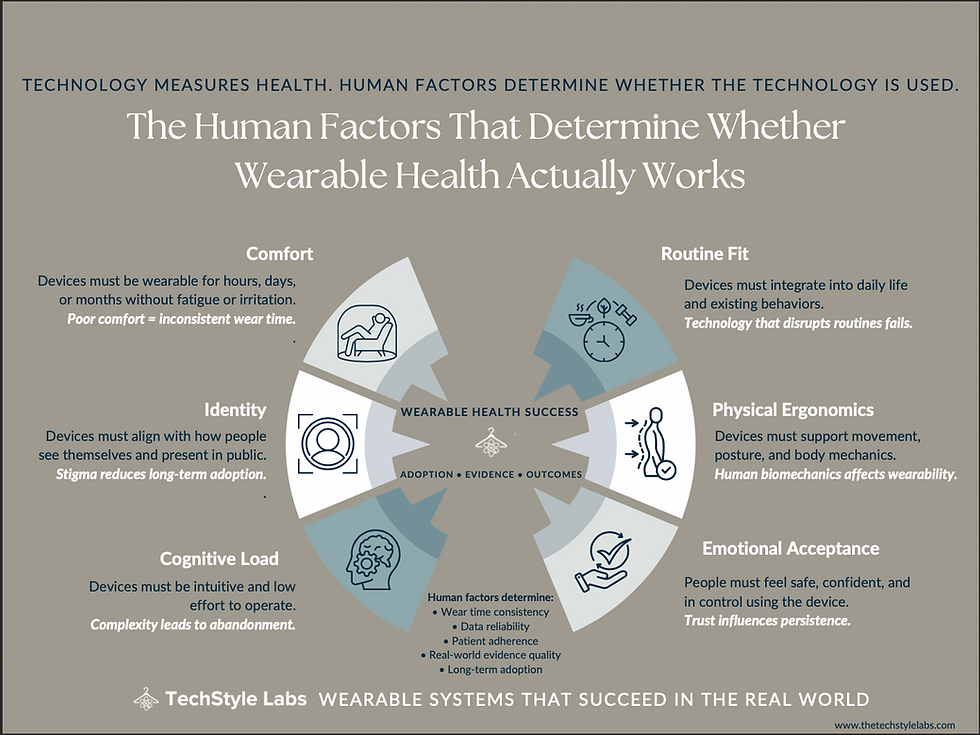
Together, these factors determine:
• Wear time consistency
• Data reliability
• Patient adherence
• Real-world evidence quality
• Long-term adoption
Wearable health doesn’t succeed because sensors work. It succeeds because people use them. When adoption improves, something else changes as well: the quality of the data. That connection is explored in why engagement is actually an evidence metric.
At TechStyle Labs, we focus on designing wearable systems that align with real human behavior—so innovation works where it matters most: outside the lab.

Comments