.png)

Empathy Isn’t Soft — It’s a Compliance Strategy
Updated: Apr 8

In wearable health, empathy isn’t sentimental — it’s the mechanism that determines adoption, adherence, and regulatory success in wearable health.
When the healthcare industry talks about empathy, it often gets dismissed as “soft.” In pharma, med-tech, and digital health, that makes it risky. Soft doesn’t get funded, soft doesn’t move milestones, and soft doesn’t convince regulators or payers.
But empathy in wearable health isn’t sentimental. It’s operational.
It’s the method we use to understand how real people live, move, sleep, heal, work, and recover — and those behaviors are the ones that ultimately decide whether a solution is actually used in the real world.
If digital health is going to scale, empathy is not optional. It’s the compliance strategy.
The Misunderstanding: Empathy as Aesthetics
In many innovation conversations, empathy gets reduced to:
Making products look nicer
Improving “experience”
Adjusting colors, finishes, or fabric choices
Those can matter, but they’re surface-level.
Empathy in regulated environments is not an aesthetic variable. It is a behavioral and operational variable — and those are the ones that decide whether patients use a therapy as prescribed, whether data is reliable, and whether endpoints can be measured at all.
The Real Definition: Empathy as Operational Insight
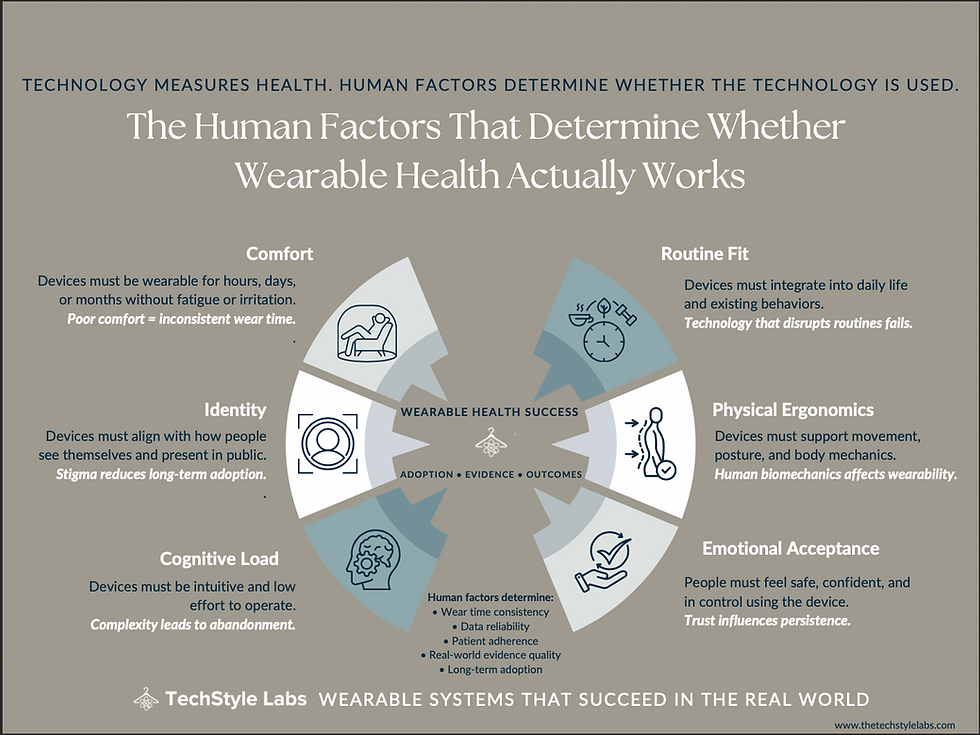
For TechStyle Labs, empathy means building an evidence-based understanding of:
What a therapy feels like in daily life
How it integrates (or doesn’t) into routines
How it changes mobility, confidence, or identity
What it demands of caregivers
Where friction creates abandonment
These are not emotional concerns — they are adoption drivers.
And adoption drives compliance.
Compliance drives outcomes.
Outcomes drive reimbursement, regulation, and commercialization.
Why It Matters More in Wearable Health
Unlike pills or infusions, wearables don’t just need to be tolerated. They need to be worn — consistently, correctly, and often for long periods of time.
If a wearable is uncomfortable, stigmatizing, inconvenient, or incompatible with daily life, patients simply stop using it. And when they stop, everything downstream breaks:
Clinical trials fail
Data streams collapse
Digital endpoints become invalid
Payers hesitate
Scale slows or stops
Non-adherence isn’t soft — it’s expensive.
Digital Health Needs Real Humans
Industry often treats digital health as a data challenge. But data only exists if real humans generate it.
Consistent data depends on consistent use.
Consistent use depends on comfort.
Comfort depends on empathy.
This is not philosophy. It is the physics of adoption.
Identity and Dignity Are Compliance Variables
Patients don’t disappear when devices are turned on. They have identities, professions, clothing preferences, social lives, bodies, and agency.
If a therapy makes someone feel “other,” data becomes inconsistent and abandonment rises.
From a clinical or payer perspective, dignity and identity stop looking “soft” and start looking like:
Quality of Life (QoL) scores
Therapy persistence
Rehabilitation timeline
Caregiver burden
Dose fidelity
Adherence rates
Trial retention
These are the metrics that determine whether a therapy reaches scale.
Empathy Reduces Risk — For Everyone
When we design with patients instead of for them, we reduce risk across the entire chain:
For Pharma — fewer trial failures due to endpoint non-compliance
For Med-Tech — fewer returns and abandonment cycles
For Digital Health — better real-world evidence and engagement persistence
For Payers — stronger justification for reimbursement
For Care Teams — less manual intervention and burden
For Patients — dignity, independence, and trust
That is what empathy actually buys: lower risk and higher adoption.
The Operating System for Real-World Scale
At TechStyle Labs, we treat empathy as an operating system — the disciplined method we use to understand how therapies live in the world once they leave the lab.
It drives how we design.
It drives how we prototype.
It drives how we validate.
It drives how we hand off for scale.
And most importantly, it drives compliance.
Because patients are the experts in their own experience — and experience determines whether digital health becomes infrastructure or remains an experiment.

Comments