.png)

Health Monitoring Can’t Live on the Wrist Forever - The Evolution of Wearable Health Monitoring
Updated: Oct 3

The wrist changed health technology.
A device people were already comfortable wearing became a platform for tracking movement, sleep, heart rate and, increasingly, more sophisticated health signals. Smartwatches and fitness trackers made continuous health data familiar to millions of people who had never thought of themselves as using a medical or monitoring device.
That was an important shift. The wrist offered good sensor placement, relatively little disruption to daily life and a form factor people already understood. It also helped prove that people would live with technology that collected health information throughout the day.
But the success of the wrist has shaped how we think about wearable health. We have become very good at measuring what can be measured conveniently from one small part of the body.
There is much more to understand.
Health happens everywhere
Consider a patient recovering from surgery. Heart rate and activity can tell us something about recovery, but they don't tell the whole story.
Can the patient dress independently? Are they protecting the surgical site? Is swelling changing how clothing or a brace fits? Are they moving differently because something hurts? Are they following the recovery protocol when no one is watching?
The same issue appears across healthcare.
For someone living with rheumatoid arthritis, dexterity and fatigue can change dramatically from one day to another. A person using compression therapy may stop because the garment is uncomfortable or difficult to manage. Someone at risk of falling may move safely in a clinic but struggle with stairs, footwear or obstacles at home. These aren't edge cases. They're part of health.
Yet many of the things that influence outcomes are difficult to understand from a wrist-based device alone.
What are we missing?
Wearable health has spent years getting better at collecting physiological data. The next challenge is understanding more of the context surrounding that data.
That may include gait and joint mechanics. Pressure and force distribution. Posture. Changes in mobility. Whether a prescribed garment or device is actually being used. How someone responds to fatigue. Whether an intervention interferes with dressing, sleeping, working or leaving the house.
It also includes things that are harder to quantify.
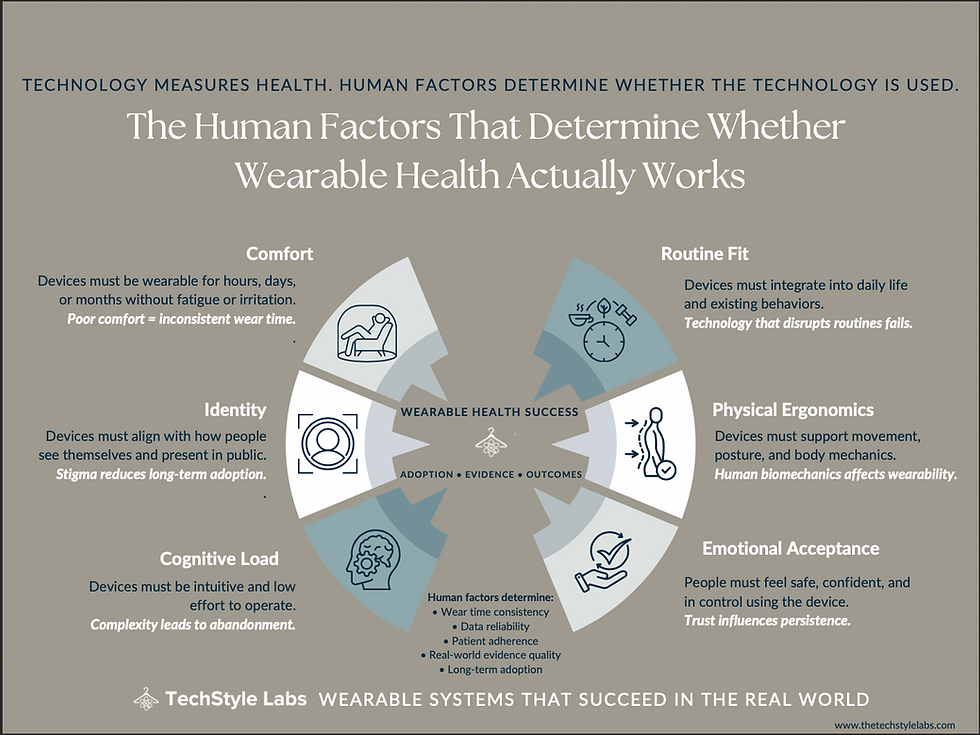
Comfort matters. So does confidence. Visibility matters when someone doesn't want to look like a patient everywhere they go. A device that requires frequent adjustment may be manageable for one person and exhausting for another.
These factors can determine whether someone continues using a health technology long enough for it to make a difference. A technically successful device sitting in a drawer doesn't generate useful longitudinal data.
The world is part of real-world evidence
Healthcare increasingly talks about real-world evidence, but the "real world" deserves more attention.
People manage their health in kitchens, bathrooms, cars, workplaces and grocery stores. They travel. They get tired. They forget things. Their bodies change. Their schedules change. They make tradeoffs.
A wearable system enters that environment whether its designers planned for it or not.
This is why we believe human factors need to be considered much earlier in wearable development. Waiting until a pilot to discover that something is uncomfortable, difficult to put on or disruptive to a daily routine is expensive. More importantly, those problems can affect adherence and the quality of the evidence a system ultimately produces.
Understanding the environment around the technology can be as important as understanding the technology itself.
Beyond the wrist
Moving beyond the wrist doesn't mean moving away from it. Wrist-based devices will continue to be enormously useful. The opportunity is to add other places, form factors and ways of sensing when the health question requires them.
Apparel is one obvious example. Clothing already moves with the body, covers clinically useful areas and is part of daily life. It creates opportunities for embedded sensing, biomechanical monitoring, post-surgical support and passive data collection without asking someone to adopt an entirely new object. Other applications may involve footwear, braces, compression garments, rehabilitation devices or technologies designed around a particular activity or environment.
The right form depends on the problem.
That's an important distinction. Starting with the health question rather than a preferred device opens up a much larger design space.
Adoption belongs in the design conversation
One of the most consequential questions in wearable health is also one of the simplest:
Will someone actually use this?
Not for an afternoon demonstration. Not for a two-week study with frequent support. Will they use it at home, at work and on a difficult day six months from now?
Answering that requires more than sensor performance.
A person may stop using something because it hurts. Or because it's embarrassing. It may be difficult to clean, difficult to put on, incompatible with their clothing or one more task in a day already full of health-related tasks. Those experiences aren't separate from product performance. They are part of product performance. At TechStyle Labs, this is why we spend so much time thinking about the relationship between the body, the technology and the life happening around both.
A larger opportunity for wearable health
For biopharma, med-tech and digital health teams, expanding the wearable health conversation creates opportunities well beyond collecting another stream of vitals.
Wearable systems may help us understand functional change between visits, support adherence, observe recovery, capture meaningful real-world endpoints and identify barriers that aren't visible in clinical data alone.
They may also give us a better picture of what living with a disease, treatment or device actually looks like. That requires engineering, but it also requires biomechanics, apparel, human factors, clinical knowledge and patient experience to inform one another.
The wrist gave wearable health an extraordinary starting point.
Now we have the opportunity to think about the rest of the body, the environment around it and the person living inside it.
The future of wearable health has a lot more territory to explore.

Comments