.png)

Why Adoption Is the Real Endpoint in Wearable Health Innovation
Updated: Apr 8

Wearable health has expanded what we can measure.
Heart rate. Movement. Sleep. Temperature. Activity.
But measurement is not the same as evidence. And evidence is not the same as impact.
The real endpoint in wearable health is not whether a device can collect data.
It’s whether people actually use it.
The Hidden Assumption in Wearable Health Innovation
Most wearable innovation is still built on a quiet assumption:
If the technology works, the system works.
In practice, that assumption breaks down quickly.
A wearable can function perfectly in controlled environments and still fail the moment it enters daily life.
Why?
Because our daily lives are not controlled laboratory environments.
We are individuals. Individuals who move. We are “messy.” We forget… and when a device doesn’t fit into our lives, we don’t use it.
Adoption Drives Everything That Follows
When adoption is inconsistent, everything downstream is affected:
Data becomes fragmented
Signals lose continuity
Insights become unreliable
Evidence weakens
Outcomes become questionable
In regulated environments—biopharma, med-tech, and clinical trials—this isn’t a minor issue.
It’s foundationally disruptive to our detriment.
Because in these systems:
Evidence is based on using the product.
And use is reliant on minimal friction.
The Chain: Adoption → Data → Evidence → Outcomes
Wearable health systems operate as a chain:
Adoption → Data → Evidence → Outcomes
Break the first link, and everything else degrades.
This is why adoption is not a “user experience” metric. It is a clinical, operational, and commercial variable.
Why Adoption Fails
Wearable systems rarely fail because of sensors or algorithms.
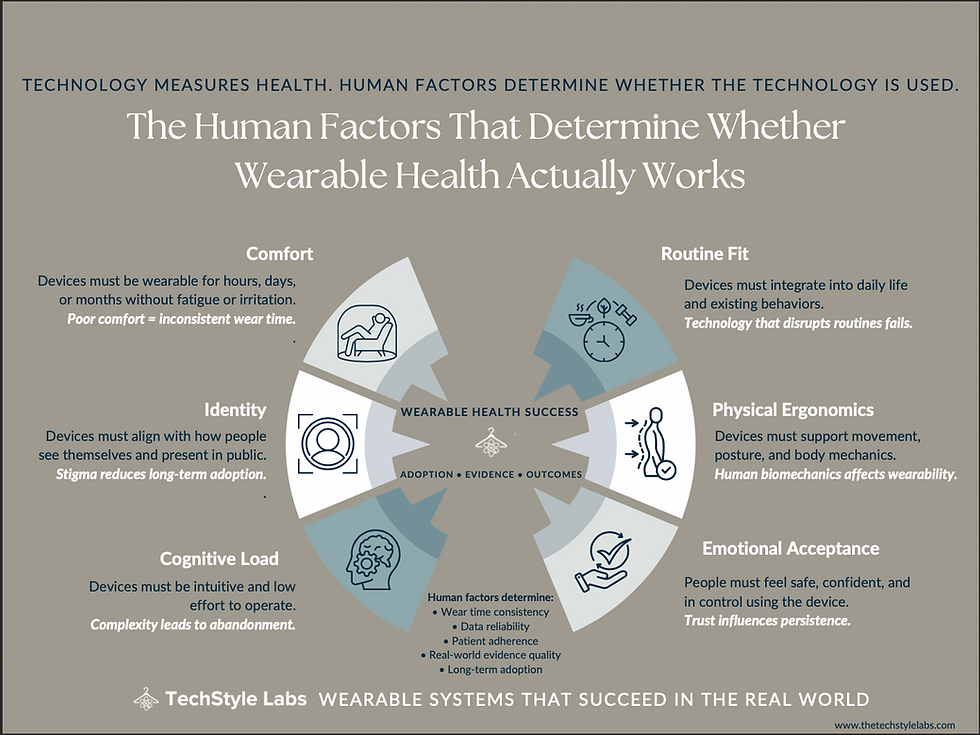
They fail because of human factors:
Devices are uncomfortable
They create cognitive burden
They don’t fit into daily routines
They conflict with identity
They introduce friction into already complex lives
These results are not outliers. They are predictable points of failure.
And they are often discovered too late—after resources are spent and after
development, validation, or even deployment.
Adoption Is a Design Problem
Adoption is wrongly framed as a behavior problem, when it is a design problem.
When wearable systems are:
Comfortable
Intuitive
Aligned with identity
Integrated into daily routines
…adoption increases naturally.
And when adoption increases:
Data stabilizes
Signals strengthen
Evidence becomes reliable
Outcomes improve
… which is simple cause and effect.
Why This Matters for Biopharma and MedTech
I
n decentralized trials, remote monitoring, and digital biomarker development, adoption is not optional.
It determines whether:
Endpoints are valid
Data is defensible
Regulators have confidence
Therapies succeed outside the clinic
A wearable that is not used consistently cannot generate reliable evidence.
Unreliable evidence introduces serious clinical, operational, and commercial risks.
The Shift: From Measurement to Use
The first wave of wearable health focused on measurement.
The next wave will focus on use.
From: Devices that measure
To: Systems that are used
From: Data collection
To: Data reliability
From: Technical feasibility
To: Human adoption
This is the shift that will define the next phase of wearable health innovation.
Where TechStyle Labs Fits
TechStyle Labs operates at the point where wearable innovation is most fragile:
Before the handoff for scale.
We focus on identifying and solving adoption risks early, when design decisions still influence real-world use.
By treating patients as experts in their own experience, we design systems that:
Reduce friction
Align with daily life
Support identity and dignity
Improve long-term adoption
Because wearable health doesn’t succeed when devices work. It succeeds when people use them.
Closing Thought
Adoption shouldn’t be a secondary metric. It is the mechanism that determines whether wearable health systems produce real-world evidence, and in healthcare, evidence determines everything.
If you're interested in how this translates into real-world innovation, you can explore how we partner with teams to bring wearable solutions into daily life.

Comments